Showing posts with label African Food and Culture. Show all posts

Apr 30, 2013

Ivorian Aloco {Fried Plantain and Palm Oil}


Delicious, caramelized fried ripe plantains were my favorite snack during my growing up years in the Cote d'Ivoire (Ivory Coast). Known as aloco in the the Cote d'Ivoire, this dish is usually eaten as a snack served on a piece of newspaper, or the evening meal alongside achekey (a couscous like dish made with grated fermented cassava, usually spelled attieke), pepper sauce, and fried fish. Somehow the combinations of these things is just amazing! The western palate, however, general prefers sweet plantain not mixed with savory fish and pepper. 

In Liberia this dish is usually referred to simply as "fried plantain", and in Ghana it's known as kelewele.  Plantain is a very popular food throughout West Africa, and African in general, as well  as many South American countries where the plantain, also know as the cooking banana, is readily available.


Plantains are prepared in a number of ways in West Africa, and are a nutritious part of the indigenous diet. They can be thinly sliced and fried green to make a chip very similar to potato chips (only better!), they are fried when the fruit is yellow and ripe, as is pictured above, which tastes more like soft French fries, or they can be fried when the plantain is black and appears to be rotten, as is done with aloco. In the Cote d'Ivoire plantain is also boiled then beaten in a mortar with boiled cassava to prepare futu, a delicious doughy starch served with meat gravy. Plantains are also served roasted when very ripe over low coals, which is another personal favorite.


When fried with a healthy oil, such as palm oil as is traditionally done, aloco can be a healthy side dish or snack. Aloco is an example of a modern day tribal food and is appropriate for paleo, primal, whole foods, and traditional foods diets. The basics to this recipe are plantain, oil, and salt, but some people add ginger, garlic, hot pepper, onions or a combination of these. My favorite is the ginger. 

Plantains are now available at most large supermarkets, as well as ethnic food stores. You can often find rich red palm oil at your local ethnic food store as well, or order it online at Tropical Traditions. Those who may not like the earthy taste of palm oil should now that it blends perfectly with the plantain and any strong taste is no longer noticeable.

Many people who grew up in West Africa crave aloco. But there are several tricks to getting that authentic taste. First of all, you want the fruit to be at the perfect stage of ripeness. Like the banana, as plantains ripen the starches are converted into sugar and the fruit gets more and more sweet. This is part of the secret to aloco. The plantains should be black with a few spots of yellow still visible.  If you notice some mold developing on the skin the fruit is getting too ripe and starting to spoil beneath the peal. (Though portions of it will probably still be okay to cook). Cooking them has to be done correctly as well. You want the pieces to be perfectly caramelized without falling apart or burning.

Aloco-perfect plantains. Mostly black with a touch of yellow still remaining.

Ivorian Aloco

3-4 Tablespoons palm oil or coconut oil (preferable unrefined for no coconut taste)
2 very, very ripe plantains, cut into 1/2 to 1 inch pieces (not sliced)
2-3 teaspoons finely chopped or grated ginger root, optional
1/4 teaspoon salt

In a heavy skillet, heat the oil over medium-low heat (number 4 on my stove) for about five minutes. Combine the remaining ingredients. Spoon the plantain evenly into the pan. Cook for about five minutes, then with a fork, carefully turn the pieces. Do not use a spatula or spoon as the pieces will be very fragile since they're so ripe. Cook for another 15 minutes, turning carefully at each five minute interval until the pieces are caramelized and dark brown. 

Remove from the pan with a slotted spoon and drain on a paper towel. Or don't drain if you aren't bothered by healthy oil!

Preparation time: 2 minutes. Cook time: 20 minutes. Servings: 2-3


After about 5 minutes of cooking.

Perfectly caramelized.

{This recipe is linked up at Tasty Traditions and Whole Foods Wednesday.}


 What ways have you found to incorporate plantains into a modern diet?

Mar 25, 2013

Liberian Greens And Rice


Stewed greens served over rice is one of the most common and well-known Liberian meals. It's also served in many other West African countries including the Cote 'd Ivoire (Ivory Coast), Guinea, and Sierra Leone. In Liberia all the toppings served over rice are referred to as "soup" and usually contain meat, onions, palm oil (refined or unrefined, depending on the recipe), and hot hot peppers. Clean sinuses and a sweating brow are common side effects to eating traditional Liberian food!

There are many kinds of greens used in these stews including sweet potato greens (Liberian "potato green soup"), collard greens, cassava (tapioca) greens, and several types of indigenous greens. The Liberian cabbage soup is also made with this same recipe.  


The Liberians who still live in villages (about 50% of the population), plus a fair number of those from urban areas, grow small patches of sweet potato greens, cassava/tapioca greens and sometimes collard greens and cabbage. Women and children can frequently be found in their gardens picking fresh produce to cook later that day. (You can read more about Liberian agriculture here). Wild greens that grow in the surrounding jungle are readily available and used for stewed greens as well as a number of medicinal preparations.


Produce is often transported to larger towns and sold in market places such as the one shown here. The large blue bucket with greens overflowing are for a meal, and the dried greens under the table are for  medicinal use. In the villages food and goods are most often transported by people traveling on foot and carrying sometimes incredible loads on their heads.


The greens are always shredded very finely for the meals. The cassava greens are actually pounded in a mortar with a pestle into a fine mealy texture. 
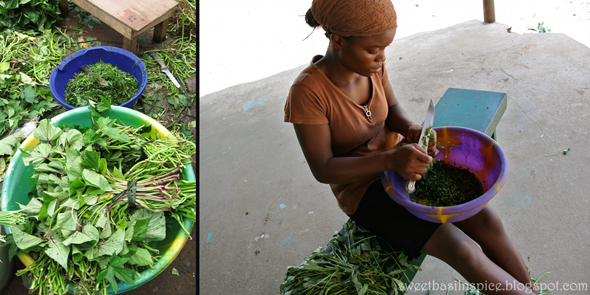


Here my friend Eveline is shredding potato greens. The greens are packet tightly into a bundle then shredded with a sharp knife very close to the hand. The skill these women have in shredding the greens by hand never ceases to amaze me. Little girls are taught to do this at an early age and I've never heard of anyone cutting themselves. 


A few notes about this recipe:

1. This is my recipe for Liberian greens. It is for collard greens with palm oil, but I used kale as it is more readily available and cheaper than collard greens, yet has the same flavor when cooked. But the recipe is very versatile and can be used with a number of dark leafy greens as well as cabbage. Spinach does not work with Liberian greens recipes as it is too tender and becomes mushy. Authentic Liberian cassava leaf and potato greens can sometimes be found in the frozen section of African food markets. The Liberian sweet potato is different than the American variety. Some people have found success using the American variety in Liberian potato greens soup, while others say it is just not the same.

2. Traditionally bone-in meat is used for all the Liberian stews. The flesh, skin and cartilage are all chewed off the bone and the marrow is even sucked out the ends. Though this seems gross to most Americans, this is crucial for receiving vital nutrients found in the bones for the Liberians to remain healthy. We'd do well to learn something from these tribal diets, though I've used chopped pieces of meat in my recipe as this is much easier to eat and more kid friendly.

3. I've used palm oil in the recipe as this is the most popular oil in this region of the world. I also wanted to offer a recipe to other Traditional and Paleo foods followers who are looking for ways to incorporate this nutritious oil into their diets. But I've given other oil options as some Liberian recipes use refined palm oil which does not have the distinct flavor of the unrefined palm oil. Refined coconut oil, lard or tallow would be healthy oil options, but for those who simply stumbled across this recipe for a Liberian greens recipe, canola oil or peanut oil may be used. Palm oil can be purchased online from Tropical Traditions, or you will probably be able to find some in your local ethnic food store. (My local hispanic food store carries palm oil.)

4. This recipe is paleo approved. It can be eaten without rice for those who are avoiding all grains, but naturally it is going to be best and most authentic served over rice. For grain-free diets I suggest trying the greens on cauliflower "rice".

5. Weigh the greens at the grocery store to make sure you purchase enough. You will need way more than you think you need as they shrink down so tiny! Shredded, one pound will probably be at least 16 cups.

6. Plan ahead as this recipe is fairly time consuming due to all the preparation of the greens as well as cutting the meat into pieces. But the greens can be cut in advance, up to two days, and the completed recipe freezes very well.

7. Dark leafy greens are actually more nutritious when cooked. The Liberians simmer their greens for over an hour sometimes! My recipe only needs about 20 minutes, but for those who are worried that you'll be killing all the nutrients, don't worry - you'll actually be making a number of them more available. (For example, some vitamin C is lost during cooking, but way more calcium is available after cooking).


Liberian Greens and Rice


Ingredients:


1 to 1 1/2 pounds hearty dark greens such as collard greens, kale, or even cabbage. I've used beat tops and also suggest trying turnip and mustard greens. (You will shred these, instructions below).
1 large onion, finely sliced
3 cloves of garlic, minced
1 pound uncooked meat, such as beef, chicken, lamb or pork, cut into 1-inch cubes
1 teaspoon seasoned salt or regular salt
2 tablespoons traditional fat like palm oil, bacon grease, lard, tallow, refined coconut oil, (canola oil or peanut oil may be used*)
1 tablespoon fish sauce, worchestishire sauce, or even 2 tsps anchovy paste**
2 tablespoons liquid aminos (coconut aminos are paleo) or 1 large bullion cube (preferable MSG-free). Salt can be used if you don't have or choose not to use either of these. I would start with 1 teaspoon and work my way up.
1/3 cup palm oil or refined coconut oil, lard, tallow, canola oil, or peanut oil*
3 tablespoons tomato paste
1/2-1 teaspoon chipotle pepper powder, cayenne pepper, or 1 minced habanero pepper, seeds removed, optional
a few drops of liquid smoke, optional

Short grain brown rice, or rice of choice for serving, at least 1 1/2 cups cooked rice per person.

*Canola and peanut oils are not healthy oils but are fine to use if you have just come here for the Liberian recipe and don't have any of the other suggested oils.

**In Liberia this very subtle (and not fishy at all) flavor would be achieved by the addition of several small dehydrated fish.

Prepare the greens:


Begin by washing and shredding the greens. Rinse of the greens with cool water to remove any sand or soil. Pat dry with a clean towel. For larger greens like kale remove the thick woody stems. Stack the leaves together then roll up into a fist-sized bundle and slice with a very sharp knife as small as possible. I aim for 1/4 inch, but even that is hard to achieve (most slices end up being thicker). Before my food processor met an untimely death I was able to shred them with the shredding blade (not the chopping blade in the many compartment of the machine), but I was not able to shred them with my Kitchen Aid's shredding attachment. The more finely they are shredded the more authentic - and digestible - they will be.

Pile the shredded greens into a very large bowl. Once they are all shredded run clean water into the bowl and swish the greens around to remove any bits of soil that may have remained. The sand should have settled to the bottom of the bowl so you'll want to lift the shredded greens out by the fistful and place in another large bowl. If there was a lot of sand on the bottom of the bowl you'll want to repeat this process once. Do not shake out the greens as the water left in them is just the amount of water you will need to add to the sauce. (There should be about 2 cups water that cling to the greens).

Slice the onion and mince the garlic and place on top of your pile of greens. Now that the greens are ready, you can proceed with cooking the meat.

Cook the recipe:

Turn the heat to medium and melt two tablespoons oil in the bottom of a large pot. Add the meat and sprinkle with seasoned salt. Cook, stirring occasionally until the meat is cooked through and starting to brown. Remove from the pot and keep warm in a bowl.

Dump the bowl of greens (and onions and garlic) into the oil in the bottom of your hot pan. You may need to do it in two batches after the first batch wilts a bit. Put a lid on the pot and stir every few minutes to mix the greens down and make sure they cook evenly.

Stir in the remaining ingrediants. Once smooth and incorporated taste to see if it needs more salt. Add the meat and reduce the heat to low. Simmer for about 20 minutes or until the greens turn very dark green.

Serve over hot short grain brown rice to be the most authentic, or the rice of your choosing.

Preparation time: 1 hour. Cook time: 40 minutes. Servings: about 6.


Click here to view my other Liberian recipes, and stay tuned as 
I continue to post more delicious West African recipes!


Sep 8, 2012

Liberian Groundpea Soup and Rice

Groundpea Soup; the Liberian name for the popular African dish of Peanut Sauce which is usually served over rice.

Peanuts for sale in Liberia. My photo.
Known as Sauce Arachide in the Cote d'Ivoire and French speaking West Africa, and Groundnut Stew in Sierra Leone and Ghana, Peanut Sauce is not only common in West Africa, but throughout many African countries. Peanuts are easily cultivated in Africa's warmer climates, and the countries of Senegal and Sudan are among the top five peanut exporters worldwide.

Liberian homes overlooking the rainforest. My photo.
Providing a cheap source of protein that will not spoil easily, peanuts are consumed regularly in Liberia. In addition to Peanut Sauce, they are eaten as a snack, both in the shell and parched, and are also used to make "Groundpea Candy" (peanut brittle), and several other peanut based snack foods.

Liberian peanut brittle. Made with just two ingrediants: caramelized sugar and peanuts. My photo.
During my time as a child in Liberia and the Cote d'Ivoire (Ivory Coast), Peanut Sauce, or Peanut Butter Soup as we called it, was one of my favorite African meals. The dish varies from country to country, with some recipes calling for rich red palm oil and a mix of local vegetables, some being tomato based, and some, like the Liberian version, being a simple smooth sauce. This recipe is one of the easiest to make with surprisingly authentic flavors despite being made with American ingredients in an American kitchen.

Liberian child eating with her hands as is customary. My photo.
This recipe is from my brother John-Mark Sheppard who also spent several years working in Liberia as an adult. He and his wife Sara and my adorable niece Audrey are heading back to Liberia this fall as long-term missionaries.

John Mark in Liberia.
Another cool thing about John-Mark is that he has just published a book! Cracking the Code: The Confused Traveler's Guide to Liberian English is a Liberian English dictionary and culture guide. It's an invaluable resource for anyone who is a missionary in Liberia, anyone visiting Liberia, or those who have adopted from Liberia. John-Mark is a great writer and he has put a ton of time and research into this excellent resource. 


Go to their blog Wherever I Send You to learn more about the Sheppards and the ministry they will be doing with Muslims in the northern part of Liberia.

John-Mark uses boneless beef pieces in his recipe but I prepared this recipe with bone-in chicken pieces as this is how I usually ate it in Liberia. When we were served Groundpea Soup it was always with generous hunks of bone-in meat as this is how Liberians honor their guests. On a day to day basis your average family would have at least a small amount of dried fish in their sauces, but for guests a chicken may even be killed and added to the sauce. I've included boneless and bone-in options for this recipe. Using boneless meat pieces is easier to prepare and eat, especially if you are serving this to children.


Liberian Groundpea Soup

2-4 tablespoons peanut oil* (can sub refined coconut or palm oil)
1 pound cubed beef or chicken OR 4-6 pieces bone-in chicken pieces (I used thighs)
Seasoned salt
1 medium onion, finely chopped
3 cloves garlic, minced

3/4 to 1 cup natural peanut butter (unsweetened creamy is best)
3 to 3 1/2 cups water
1/4 cup tomato paste
1 large bullion cube, MSG-free (can sub 2 tablespoons liquid aminos)
1/2 to 1 1/2 teaspoons chipotle chili pepper or comparable hot pepper powder with smokey flavor, or if you do not like hot pepper, use a few drops of liquid smoke.*

Brown rice, or rice of choice for serving, approximately 1 to 1 1/2 cups cooked rice per person.** 

Step 1: To prepare with bone-in meat:

Season chicken with seasoned salt by rubbing it all over the piece. Use approximately 1/8 teaspoon or a little more per piece.

Heat 2 tablespoons oil over medium heat in a small pot (about 4 quart size). Heat another 2 tablespoons oil in another skillet. Fry chicken in the two skillets until browned on both sides - about 5 minutes per side. Turn off the heat and remove chicken from the pans. Keep warm in a covered bowl. Discard the extra skillet and the oil in that skillet.

Step 1: To prepare with boneless meat pieces:

Season the meat with about one teaspoon seasoned salt. Add 2 tablespoons oil to a small pot. Heat over medium heat for about 2 minutes. Add the meat and fry, stirring occasionally until fully cooked and  browned - about five minutes. Remove the meat from the pan and keep warm in a covered bowl.

Step 2: For both kinds of meat:

Return the pot to medium heat. There should be oil left in the bottom from frying the meat. Add the onion and garlic and saute until the onion is translucent. Add the remaining ingredients and stir until the peanut butter is disolved. A whisk may help to break apart the chunks. Bring to a boil. The sauce should be the consistency of a cream sauce. If it seems too thick add an additional 1/2 cup water. Return the meat to the pan. Turn the heat to low and cover the pot. Let simmer for at least 20 minutes or until the bone-in chicken (if using) is cooked through and the sauce is smooth and of uniform consistency.

Serve over brown rice, or rice of your choice.

*Hot pepper and smoke flavoring are optional, but create the most authentic dish. Hot pepper is essential to almost all Liberian sauces and since the food is cooked over an open fire everything picks up a delicious smoke flavor.

**If using brown rice it's important to prepare it properly as rice is such a significant part of the Liberian diet. See my recipe here for Basic Brown Rice.

Preparation time: 10 minutes. Cook time: 35-45 minutes. Servings: 4-6.

Sep 3, 2012

Basic Brown Rice and Rice Preparation in Liberia

Rice is one of the most common grains in the world. It is a staple in many countries worldwide, including Liberia and the Cote d'Ivoire where I lived many years. Rice is something I make regularly and one of the changes I have made to improve the nutrition my family is getting is to replace most of the white rice we eat with brown. I will be sharing several Liberian recipes to be served over rice and using brown rice gives these meals a rustic and more authentic feel. White rice is a subsidized import in Liberia so not all the rice consumed is the locally grown brown rice. 

My photo.
Brown rice has only the husk removed leaving the germ and bran intact. Brown rice has a small amount of rice bran oil and a lot of good fiber. It's a good source of several vitamins and minerals including B1,  B3, iron, and magnesium. Brown rice has a lower glycemic index than white rice so does not raise blood sugar as white does. White rice has the germ and bran stripped and with it all the nutritious oil, fiber, vitamins, and minerals. Left behind is a refined carbohydrate. Most white rice is now sold as "enriched" with some synthetic vitamins and minerals added back, but these nutrients are minimal compared with natural brown rice. This is another example of why food is healthiest when eaten the closest to the way God made it in nature.

Brown rice does cost more than white rice, but all things considered, switching from white rice to brown rice is not a big financial sacrifice. Because of the good balance of fiber, oil, and nutrients, brown rice is more filling than white, so you eat less which does save a little on the cost. Unfortunately, most people do not know how to prepare brown rice so they believe brown rice equals hard grains while white rice is soft and fluffy. The good news is brown rice can be very fluffy and delicious if it's prepared properly. Adding salt to the water before cooking helps to bring out the flavor.  It's a little more chewy than white rice, but the flavor is fairly neutral and it goes with anything you'd usually serve with white rice.  

There are several varieties of brown rice that are inexpensive and readily available. Regular long grain brown rice is the most common and has a neutral taste. Brown Jasmine rice has all the health benefits of brown rice with the delicious aromatic flavor of Jasmine rice. There is also brown basmati rice but it is a bit more costly and I have not tried it yet.

Wal-Mart brand brown rice was $0.72 a pound the last time I bought some. I was able to find brown Jasmine rice at an ethnic food store for about the same price as regular brown rice, which is a very good deal. If you eat a lot of rice and like Jasmine rice, I would look at your local ethnic food store for the best price. Brown basmati rice was more expensive (basmati rice is already more expensive than regular rice) but if you eat a lot of basmati rice it would be worth it to switch to brown basmati.

Rice is one of the grains that does not have to be soaked, according to Nourishing Traditions. You can soak it, but it does not make a huge difference. Rather, it is suggested to cook rice with a good quality homemade meat broth to make the most of the nutrients. I don't do this with all my recipes, but I try to when I can as it does significantly increase the nutritional value.

Here are two practical and informative recipes by other Nourishing Traditions followers on making your own meat broth:


Rice in Liberia:

Rice in Liberia is so popular and important a common Liberian saying is that one has not eaten unless they have eaten a meal that included rice. It is even believed that rice is essential for a Liberian to eat in order to maintain good health.

Nutritious brown rice - also known as African red rice - is grown by subsistence farmers in various varieties and hues, some being almost purple in color. Farmers plant their own rice grains, saved from a previous harvest, cultivate it, harvest it, then store it in bundles still on the stalk. Each day when it is time to begin preparing dinner, the rice is pounded in a mortar to remove the husk. This job is done by women or children with sometimes two or three people taking turns pounding a pestle in rhythm.


After the husk is removed, the rice is shaken in a rice fan to remove the chaff.


Finally it is rinsed then added to a pot of already boiling water. 


Salt is added and the rice is stirred from time to time to prevent burning.  Excess water is poured off as needed. This rather complicated method of cooking the rice could be because of the unstable heat from an open fire, but creating perfect brown rice in your own kitchen is a lot easier. There are several ways to make brown rice successfully, but this method works well for me.

Note: Rice can be prepared with almost any liquid. Using water is the most authentic for Liberian recipes, using broth is the most nutritious according to Nourishing Traditions. 

Basic Brown Rice

1 1/2 cups brown rice
3 cups water or broth
1/2 to 1 teaspoon salt, optional

Combine all ingrediants in a 2 quart sauce pan. Bring to a boil over medium heat. Reduce heat to low and simmer covered for 45 minutes. Fluff rice with a fork before serving.

Preparation time: 1 minute. Cook time: 50 minutes. Servings: 4-6.

Tips for success: Do not peak under the cover, do not stir while cooking, and set a timer for 45 minutes.  This method works every time for me.

Brown rice can be successfully frozen and reheated. This is a great way to make sure you always have the time to eat brown rice since one does not always have 45 minutes to prepare the rice. I freeze portions in the amount we need for one meal then thaw and reheat as needed.